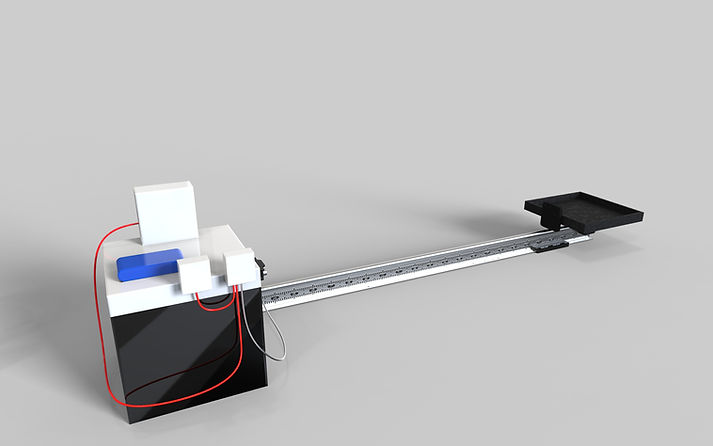
BrainHero Toss v1
BrainHero Toss is a closed-loop attention training system that combines a 3-electrode EEG headset, brief cognitive tasks, and a physical ball-throwing device for neurodivergent children and under-resourced settings. In each short session, it records an individualized EEG baseline, tracks attention in real time from brain and behavioral signals, and triggers a ball to hit a moving tray as a tangible reward when an attentive state is sustained. Task difficulty and device behavior adapt online to keep performance in an optimal “flow” range, while synchronized EEG, behavioral, and device data feed a personalized deep learning framework that helps the system adjust across different users and environments, mitigating performance drops under distribution shift.


01
Hardware Design
BrainHero Toss links a 3-electrode EEG headband to a motorized rail and ball-throwing device, turning moments of sustained attention into a visible reward when a ball hits a moving tray. A small controller and sensors synchronize EEG, motion, and hits, so the system works both as a playful game and as a research-grade closed-loop platform.
02
Software & Session Flow
BrainHero Toss runs each session as a brief loop where a child wears a 3-electrode EEG headband, completes a quick calibration, and then plays 3–4 minute blocks of simple tasks that trigger ball throws when attention is sustained. A state-machine–based software stack quietly handles safety, real-time attention estimation, adaptive difficulty, and logging so the game doubles as a controlled experimental protocol.


03
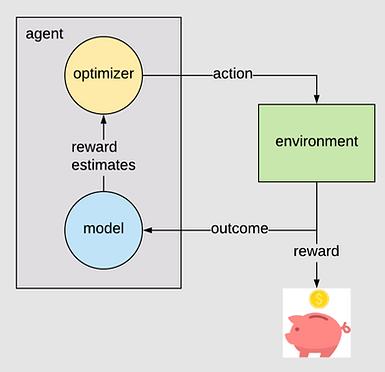
Adaptive Intelligence: Contextual Multi-armed Bandits
BrainHero Toss uses a contextual multi-armed bandit algorithm to decide, in real time, how hard the game should be for each child. The system looks at recent context—like attention estimates from EEG, accuracy, reaction times, and signs of fatigue—and then chooses among a set of difficulty presets (e.g., easier or harder tasks, slower or faster tray). Over time, it learns which settings keep that specific child in a comfortable “flow zone” instead of guessing or using a one-size-fits-all difficulty rule.
04
Validation
BrainHero Toss is designed to be evaluated like a real experimental platform, not just a game. We use pre- and post-training standardized attention tests to measure transfer beyond in-game scores, compare our full EEG+bandit system to sham and behavior-only controls, and analyze detailed logs of EEG, behavior, and device events. This lets us test not only whether children improve, but also whether our contextual bandit policy and EEG feedback genuinely add value across different environments.
-
Low executive load: one-tap start, one clear choice per screen, no point penalties—“try again” is shown with simple visual prompts.
-
Sensory-friendly: optional mute/low volume, reduced flicker and low-contrast colors, with gentle haptic cues instead of loud sounds when needed.
-
Frustration-resistant: the system automatically keeps success rates around 60–80%, switches into an “easy win” mode after repeated failures, and clearly explains that poor EEG signal is not the child’s fault.
-
Overload protection: every 2–3 minutes, a short “relax” block is built in so breaks become a legitimate part of the game rather than feeling like failure.
05