Software & Session Flow
Session Flow
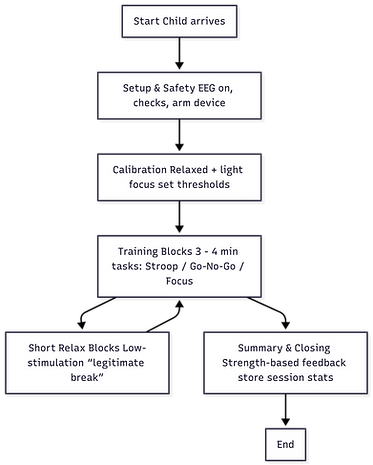
Software Flow

Setup & Safety
Child puts on a 3-electrode EEG headband; the system checks EEG quality, device status, and safety interlocks before arming the thrower.
Calibration
A brief relaxed phase and a lightly focused phase are used to set per-session attention and signal-quality thresholds.
Training Blocks
The session runs in 2–3 short blocks (3–4 minutes each) of simple tasks (e.g., Stroop, Go/No-Go, focus gauge). EEG-based attention estimates and behavioral performance jointly decide when the tray moves and a ball is launched as a reward.
Adaptive Difficulty
After each window of trials, a contextual bandit module selects one of several predefined difficulty presets (attention threshold, sustain time, response window, tray speed, task type) to keep the child in a 60–80% “flow” success range
Logging & Summary
EEG, task events, device states, rewards, and chosen presets are logged on a unified timeline, and the session ends with a brief, strength-focused summary that also seeds starting parameters for the next visit.